

A table lighter is a stationary decorative lighter, born in the 19th century as a fireside curiosity and elevated into a serious collectible by 20th-century design and luxury manufacture. Its arc runs from silver Victorian novelties through Art Deco geometry and mid-century lucite sculpture, then into decline as disposables took over. Today, materials, maker marks, and documented provenance decide what a piece is worth on the collector market.
TL;DR:
- The value of a table lighter depends heavily on its maker, materials, condition, rarity, and provenance, with documented history adding significant worth.
- Materials like sterling silver and hand-carved lucite from the mid-century period command higher prices, especially when original mechanisms and hardware are intact.
- Recognizing specific design elements and technical details allows collectors to accurately date pieces and determine their historical significance.
- Provenance, detailed hallmarks, and original features are key indicators that influence market value, with documented auction records boosting confidence in authenticity.
- Proper care involves keeping materials dry and avoiding fuel or residue buildup, as well as verifying maker marks and registration numbers for accurate dating.
Table of Contents
- A Timeline of Table Lighter Design, From Victorian Novelty to Decline
- What Materials and Techniques Reveal About a Lighter’s Age
- Which Makers and Models Define the Table Lighter Market?
- What Determines a Table Lighter’s Collector Value?
- How Do You Date and Care for a Vintage Table Lighter?
- Why These Small Objects Still Matter to Collectors
- Bring the History Home With Allurecart’s Historically Inspired Lighters
- Sources
A Timeline of Table Lighter Design, From Victorian Novelty to Decline
Every era left its own fingerprint on the table lighter, and collectors who can read those fingerprints have a real advantage at auction. The story starts long before the lighter as we know it existed in any mass-market form.
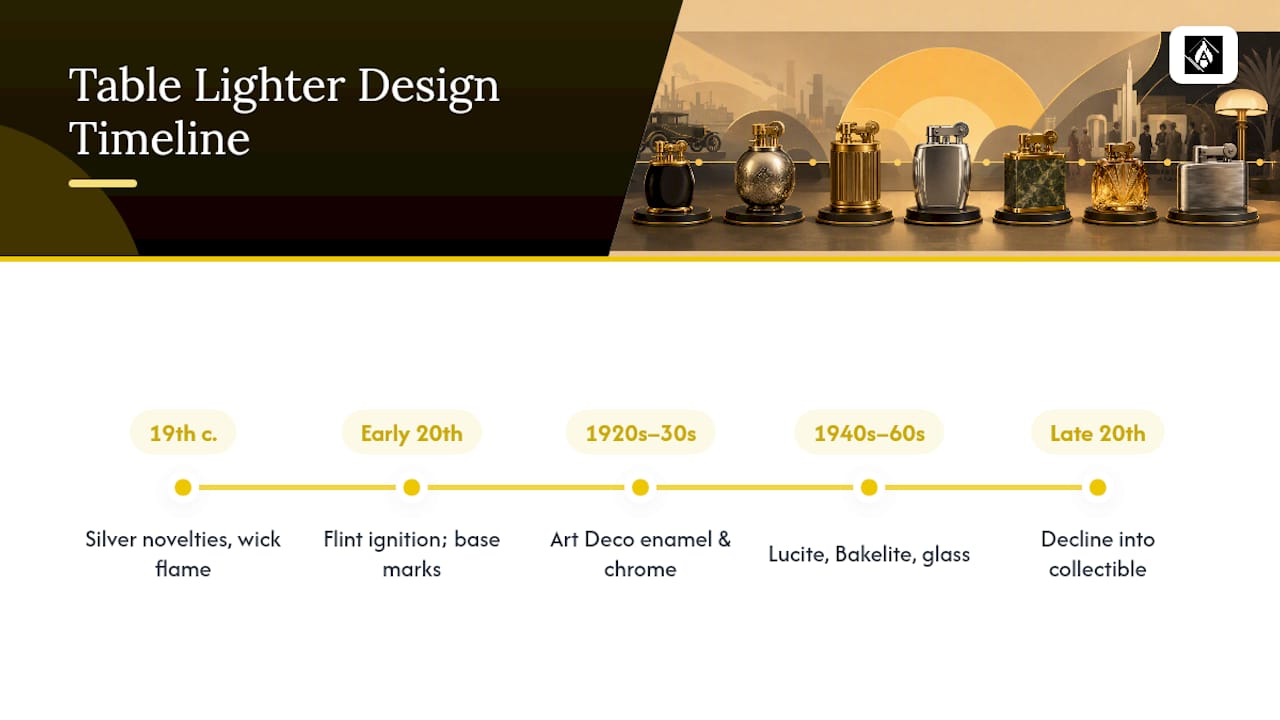
19th century: novelty and flame. Victorian table lighters were often silver novelties shaped like everyday objects, animals, or, in one striking case documented at Bonhams, a miniature field gun. That London-hallmarked 1889 piece shows how seriously silversmiths took the form: real regimental detail, cast in precious metal, built to sit on a gentleman’s table as both conversation piece and fire source. Cigar lamps and wick-based novelty pieces from this period relied on simple flame mechanisms rather than any spark ignition.
Early 20th century: mechanization arrives. Flint-and-wheel mechanisms replaced open wicks, and branded fitments started appearing in cafes and hotel lobbies as counter lighters. This is also when manufacturers began stamping registration numbers into bases, a habit that collectors depend on today.
1920s to 1930s: Art Deco confidence. Geometric silhouettes, enamel inlay, and chrome-plated brass defined the look. Lighters became small design statements meant to match cocktail sets and cigarette cases, not just tools.
1940s to 1960s: mid-century experimentation. This is arguably the golden stretch for collectors. Alfred Dunhill’s lucite “Aquarium” series, hand-carved and reverse-painted, turned a functional object into a miniature sculpture. Bakelite, sculpted glass, and porcelain bodies all competed for shelf space in this period, according to the WorthPoint dictionary of table lighters, which traces the object’s rise from the 1920s through the 1960s as its commercial peak.
Late 20th century: decline and rediscovery. Cheap disposable lighters and shifting tobacco habits pushed table lighters out of daily use, a shift collector writers at Tablesitters describe as the turn from industrial novelty to coveted collectible. What was once a practical accessory became a design artifact instead.
Reading a piece against this timeline is the fastest way to place it, even before checking a single mark.
What Materials and Techniques Reveal About a Lighter’s Age
Material tells you almost as much as a maker’s mark, sometimes more, because certain materials simply did not exist in certain decades.
- Sterling and silver-plate: dominant from the Victorian era through the 1930s, often hand-chased or engraved.
- Chrome-plated brass: the workhorse of Art Deco design, prized for reflecting geometric lines cleanly.
- Lucite: the signature mid-century material, especially in Dunhill’s aquarium pieces.
- Bakelite: common in the 1930s and 1940s, recognizable by its dense weight and slightly sweet smell when warmed.
- Crystal and porcelain: used across decades for luxury tabletop sets, often paired with metal fittings.
The most distinctive technique in the whole category is lucite intaglio carving. Dunhill’s “Aquarium” lighters, produced from around 1950, were carved from beneath using dental-style tools and reverse-painted in layers, a process explained in detail by collector reference site Mark Goodger’s guide to Dunhill aquarium lighters. Because each panel was carved and painted by hand, no two examples ever look quite the same, which is exactly why they command premiums decades later. A Decorative Fair listing for a Dunhill Half-Giant aquarium lighter circa 1950 shows the silver-plated mechanism paired with these hand-decorated panels, a combination that defines the model’s appeal.
Construction details matter too. Original screws, period-correct rivets, and the type of fuel insert used all help confirm whether a piece is intact or has been reworked.
Pro Tip: Hold a suspected Bakelite piece and run it under warm water for a few seconds, then smell the surface. Genuine Bakelite releases a faint, sweet phenolic scent that plastics from the 1960s onward simply don’t produce.
Which Makers and Models Define the Table Lighter Market?
Not every maker built for the same customer, and knowing the category a piece came from helps you judge whether a price is fair.
- Silversmiths and jewelry houses produced one-off novelty pieces in the Victorian and Edwardian periods, often marked with full hallmark sets that include maker, assay office, and date letter.
- Luxury lighter brands built mechanized inserts into decorative bodies, blending engineering with design from the 1920s onward.
- Glass and porcelain studios collaborated with lighter manufacturers to produce hybrid objects. A 1stDibs listing for a table lighter designed by Bjørn Wiinblad for Rosenthal from 1961 shows how a porcelain designer’s signature style, in this case Wiinblad’s whimsical figures, could be stamped onto a functional lighter body and still read as fine decorative art.
- Novelty manufacturers chased trends, animal shapes, military motifs, sporting themes, meant to appeal to a buyer’s personality rather than a design movement.
The Bonhams field gun lighter mentioned earlier is a useful case study in how provenance drives price: a detailed lot description naming the silversmiths, noting the overstruck marks, and dating the piece to London 1889 gives buyers confidence that a generic “old silver lighter” listing never can.
Catalog items draw directly on these historical cues without pretending to be antiques. Certain designs borrow the clock-face motif that novelty makers loved in the Victorian and Edwardian periods, when timepieces and fire tools often shared cases. Other designs nod to the transitional era when open-flame matches gave way to mechanized flint wheels, reframing that shift as a design element rather than hiding it. Still others echo the mid-century fascination with animal and travel motifs that novelty manufacturers built entire product lines around. None of these claim to be period antiques, but each one translates a real historical design language into a piece meant for daily use.
What Determines a Table Lighter’s Collector Value?
Five factors decide what a table lighter is worth on the open market, and they rarely act alone.
- Maker. A named silversmith or a recognized mid-century design house adds a floor to the price before condition even enters the conversation.
- Material. Sterling silver and hand-worked lucite consistently outperform chrome and plastic in resale.
- Condition. Original mechanisms, unrepaired finishes, and intact fuel inserts matter more than a shiny recent polish.
- Rarity. Limited production runs or one-off commissions, like the Bonhams field gun, carry scarcity value that mass-produced counter lighters never will.
- Provenance and documented sale history. A piece with a traceable auction record or estate history sells with more confidence than one with no paper trail at all.
When reading an auction listing, look past the photos to the lot notes. Details like overstruck hallmarks, noted in the Bonhams description as marks for one silversmith later struck over by another, tell you the piece has a documented chain of ownership worth researching further. Restoration is common and not always a dealbreaker: a re-flinted mechanism for display use is usually acceptable, but a replated body on a silver piece meaningfully reduces its value for serious resale.
How Do You Date and Care for a Vintage Table Lighter?
Authentication starts at the base. Maker marks, registration numbers, and patent stamps are almost always found on the underside or inside the fuel chamber, and the WorthPoint guide to table lighters treats these marks as the single most reliable dating tool collectors have.
- Check whether the ignition is flint-and-wheel or an early gas jet; auto-extinguish springs and battery ignition point to later, mid-to-late-20th-century production.
- Look for a registration number stamped near the hinge or base plate, which can often be cross-referenced against period patent records.
- Inspect screws and rivets for consistent wear; mismatched hardware usually signals a later repair.
For care, keep silver and chrome pieces dry and away from direct sunlight, which dulls lucite over time. Never leave old fuel or flint sitting in a mechanism you plan to display rather than use, since dried residue can corrode internal parts.
Pro Tip: If a lucite aquarium-style lighter feels unusually light or the color looks flat under a lamp, it may be a later reproduction rather than a hand-carved original. Genuine intaglio work has visible depth when you tilt the panel toward light.
Why These Small Objects Still Matter to Collectors
Allurecart values table lighters as design artifacts first, novelty items second. A well-carved lucite panel or a hand-hallmarked silver case carries the fingerprints of a specific maker and moment. Displaying these pieces thoughtfully, grouped by era or material rather than left scattered, keeps that history visible instead of buried in a drawer.
— Allurecart
Bring the History Home With Allurecart’s Historically Inspired Lighters
Building a collection does not have to start with a Victorian silversmith’s workshop or a Dunhill auction lot. Allurecart’s catalog gives you an accessible entry point into the same design language, at prices built for everyday collecting rather than estate-sale bidding wars.
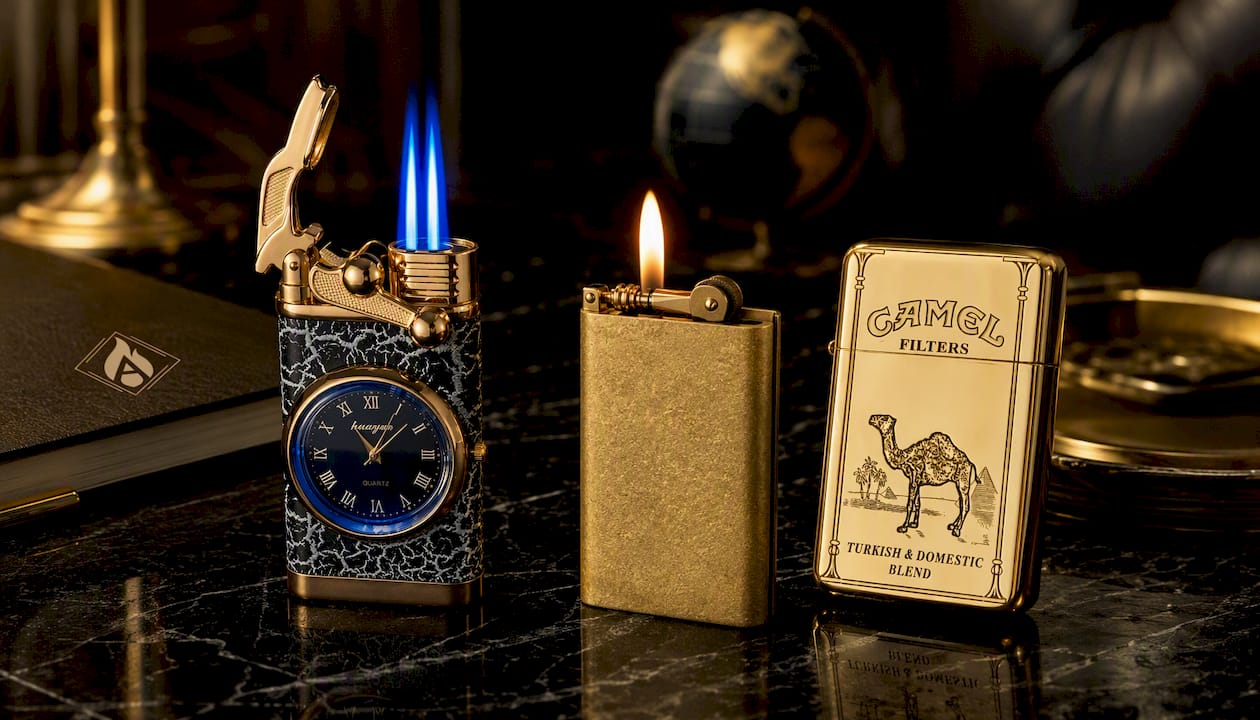
The CLOCK LIGHTER takes the timepiece motif Victorian and Edwardian novelty makers loved and turns it into a daily-use piece. The MATCH LIGHTER plays on the transition from open flame to mechanized ignition that defined the early 20th century. The CAMEL VINTAGE LIGHTER picks up the animal-motif tradition that novelty manufacturers built whole product lines around in the mid-century decades. Before buying any lighter online, whether from Allurecart or elsewhere, check the product page for the stated material, finish, and any condition notes, the same habits that serious collectors apply to auction lots. Readers who also collect cigar accessories may want to browse Thor’s Cigar Vault’s accessories category for complementary pieces.
Orders over a certain amount ship free worldwide, which makes it easy to build out a themed shelf without paying shipping on every single piece. Browse the full collection of lighters and start with whichever era speaks to you first.
Sources
- Bonhams : A rare Victorian novelty silver field gun table lighter (lot)
- Table Lighters - Guide to Value, Marks, History | WorthPoint Dictionary
- Dunhill Half Giant Aquarium Table Lighter - Decorative Fair
- Dunhill Aquarium lighters guide — Mark Goodger